


Apr 6, 2013


Apr 1, 2013
10 of the Most Legendary and Mysterious Creatures of Modern Times
There are creatures that lurk out there in the dark, that haunt the isolated forests of the world, that hide in the icy depths of the deepest lakes. They appear unexpectedly and inexplicably, then vanish just as mysteriously, usually leaving witnesses dumbfounded, frightened and, unfortunately in most cases, without a shred of evidence. But, do these creatures really exist? Did they ever exist? Or are these merely hoaxes, or the result of over-active imaginations? Even though many people claim to have seen these creatures, for most of them they are just some legends of the ancestors, passed from a generation to another, and suffering modifications at each repetition.
Here are ten of the most legendary and mysterious creatures of modern times.
Bigfoot (Sasquatch)
Bigfoot, also known as sasquatch, is the name given to an ape-like creature that some people believe inhabits forests, mainly in the Pacific Northwest region of North America. Bigfoot is usually described as a large, hairy, bipedal humanoid. The term sasquatch is an anglicized derivative of the Halkomelem word sásq’ets.

Most scientists discount the existence of Bigfoot and consider it to be a combination of folklore, misidentification, and hoax, rather than a living animal, because of the lack of physical evidence and the large numbers of creatures that would be necessary to maintain a breeding population. A few scientists, such as Jane Goodall, Grover Krantz, and Jeffrey Meldrum, have expressed interest and some measure of belief in the creature.

Bigfoot is described in reports as a large hairy ape-like creature, in a range of 6–10 feet (2–3 m) tall, weighing in excess of 500 pounds (230 kg), and covered in dark brown or dark reddish hair. Purported witnesses have described large eyes, a pronounced brow ridge, and a large, low-set forehead; the top of the head has been described as rounded and crested, similar to the sagittal crest of the male gorilla. Bigfoot is commonly reported to have a strong, unpleasant smell by those who claim to have encountered it. The enormous footprints for which it is named have been as large as 24 inches (60 cm) long and 8 inches (20 cm) wide. While most casts have five toes — like all known apes — some casts of alleged Bigfoot tracks have had numbers ranging from two to six. Some have also contained claw marks, making it likely that a portion came from known animals such as bears, which have five toes and claws. Proponents claim that Bigfoot is omnivorous and mainly nocturnal. [link]
Video: Bigfoot Documentary

Loch Ness Monster (Nessie)
The Loch Ness Monster is a cryptid that is reputed to inhabit Loch Ness in the Scottish Highlands. It is similar to other supposed lake monsters in Scotland and elsewhere, though its description varies from one account to the next. Popular interest and belief in the animal has varied since it was brought to the world's attention in 1933. Evidence of its existence is anecdotal, with minimal and much-disputed photographic material and sonar readings.

The most common speculation among believers is that the creature represents a line of long-surviving plesiosaurs. The scientific community regards the Loch Ness Monster as a modern-day myth, and explains sightings as a mix of hoaxes and wishful thinking. Despite this, it remains one of the most famous examples of cryptozoology. The legendary monster has been affectionately referred to by the nickname Nessie (Scottish Gaelic: Niseag) since the 1950s. [link]

Chupacabra
The Chupacabra (from Spanish chupar "to suck" and cabra "goat", literally "goat sucker") is a legendary cryptid rumored to inhabit parts of the Americas. It is associated more recently with sightings of an allegedly unknown animal in Puerto Rico (where these sightings were first reported), Mexico, and the United States, especially in the latter's Latin American communities. The name comes from the animal's reported habit of attacking and drinking the blood of livestock, especially goats.

Physical descriptions of the creature vary. Eyewitness sightings have been claimed as early as 1995 in Puerto Rico, and have since been reported as far north as Maine, and as far south as Chile, and even being spotted outside the Americas in countries like Russia and The Philippines. It is supposedly a heavy creature, the size of a small bear, with a row of spines reaching from the neck to the base of the tail.

Sighting reports of the Chupacabra have been disregarded as uncorroborated or lacking evidence, while most reports in northern Mexico and the southern United States have been verified as canids afflicted by mange. Biologists and wildlife management officials view the chupacabra as a contemporary legend. [link]
Video:

Yeti
The Yeti or Abominable Snowman is said to be an ape-like cryptid taller than an average human, similar to Bigfoot, that inhabits the Himalayan region of Nepal, and Tibet. The names Yeti and Meh-Teh are commonly used by the people indigenous to the region, and are part of their history and mythology. Stories of the Yeti first emerged as a facet of Western popular culture in the 19th century.

The scientific community generally regards the Yeti as a legend, given the lack of conclusive evidence, but it remains one of the most famous creatures of cryptozoology. The Yeti may be considered a sort of parallel myth to the Bigfoot of North America. [link]

Jersey Devil
The Jersey Devil is a legendary creature or cryptid said to inhabit the Pine Barrens of Southern New Jersey, United States. The creature is often described as a flying biped with hooves, but there are many different variations. The most common description is that of a kangaroo-like creature with the head of a goat, leathery bat-like wings, horns, small arms with clawed hands, cloven hooves and a forked tail. It has been reported to move quickly and often is described as emitting a "blood-curdling scream."

The Jersey Devil has worked its way into the pop culture of the area, even lending its name to New Jersey's team in the National Hockey League, and appeared on an early episode of The X-Files. [link]

Video:

Dover Demon
The Dover Demon is an alleged cryptozoological creature sighted on three separate occasions during a 25-hour period in the town of Dover, Massachusetts on April 21 and April 22, 1977. It has remained a subject of interest for cryptozoologists ever since then.

Cryptozoologist Loren Coleman was the initial investigator and the individual who named the creature the Dover Demon; it was disseminated by the press, and the name stuck. Coleman quickly assembled and brought into the inquiry three other investigators: Joseph Nyman, Ed Fogg, and Walter Webb. All were well-known ufological researchers in eastern Massachusetts, with Webb being the assistant director of the Hayden Planetarium at Boston's Science Museum. Coleman did not feel he was necessarily dealing with a ufological phenomenon, but he wanted to have seasoned investigators with good interviewing skills to do a comprehensive examination of the eyewitnesses and their families, as well as law enforcement, educational, and community members. [link]


Mothman
Mothman is a legendary creature first reportedly seen in the Point Pleasant area of West Virginia from 15 November 1966 to 15 December 1967. The first newspaper report was published in the Point Pleasant Register dated 16 November 1966, entitled "Couples See Man-Sized Bird...Creature...Something".

Mothman was introduced to a wider audience by Gray Barker in 1970, later popularized by John Keel in his 1975 book The Mothman Prophecies, claiming that Mothman was related to a wide array of supernatural events in the area and the collapse of the Silver Bridge. The 2002 film The Mothman Prophecies, starring Richard Gere, was based on Keel's book. [link]

Mongolian Death Worm
The Mongolian death worm is a creature reported to exist in the Gobi Desert. It is described as a bright red worm with a wide body that is 2 to 5 feet (0.6 to 1.5 m) long.

The worm is the subject of a number of claims by Mongolian locals - such as the ability of the worm to spew forth acid that, on contact, will turn anything it touches yellow and corroded (and which would kill a human), as well as its reported ability to kill at a distance by means of electric discharge.

Though natives of the Gobi have long told tales of the olgoi-khorkhoi, the creature first came to Western attention as a result of Professor Roy Chapman Andrews's 1926 book On the Trail of Ancient Man. The US paleontologist was not convinced by the tales of the monster that he heard at a gathering of Mongolian officials: "None of those present ever had seen the creature, but they all firmly believed in its existence and described it minutely." [link]

Orang Pendek
Orang Pendek (Indonesian for "short person") is the most common name given to a cryptid, or cryptozoological animal, that reportedly inhabits remote, mountainous forests on the island of Sumatra.

The animal has allegedly been seen and documented for at least one hundred years by forest tribes, local villagers, Dutch colonists and Western scientists and travellers. Consensus among witnesses is that the animal is a ground-dwelling, bipedal primate that is covered in short fur and stands between 80 and 150 cm (30 and 60 in) tall. [link]
Spring-heeled Jack
Spring-heeled Jack is a character in English folklore of the Victorian era who was known for his startling hops. The first claimed sighting of Spring-heeled Jack was in 1837. Later sightings were reported all over Great Britain and were especially prevalent in suburban London, the Midlands and Scotland.

There are many theories about the nature and identity of Spring-heeled Jack. This urban legend was very popular in its time, due to the tales of his bizarre appearance and ability to make extraordinary leaps, to the point that he became the topic of several works of fiction. [link]

Spring-heeled Jack was described by people who claimed to have seen him as having a terrifying and frightful appearance, with diabolical physiognomy, clawed hands, and eyes that "resembled red balls of fire". One report claimed that, beneath a black cloak, he wore a helmet and a tight-fitting white garment like an oilskin. Many stories also mention a "Devil-like" aspect. Others said he was tall and thin, with the appearance of a gentleman. Several reports mention that he could breathe out blue and white flames and that he wore sharp metallic claws at his fingertips. At least two people claimed that he was able to speak comprehensible English.
Mar 22, 2013
Building the World's Largest Ship (in 76 seconds)
A timelapse of the construction of Maersk Line's very first Triple-E vessel at the DSME shipyard in Okpo, Korea.

The timelapse was produced by Discovery Channel and Maersk, and it consists of 50,000 photos taken over 3 months.
Video:
Building the World's Largest Ship (in 76 seconds) from Maersk Line on Vimeo.
Read more about Maersk Line's Triple-E vessels here: worldslargestship.com
Mar 18, 2013
11 Most Bizarre European Ossuaries
Across Europe in many predominantly Catholic or Orthodox countries are sites known as ossuaries, often referred to as "bone churches".  Creepy by today's standards, these churches decorated from floor to ceiling with human skeletal remains were often used in places where major plagues had hit or where burial space had become scare. Though the original intention in many areas was for bones to be buried when space became available, many of these remains are still up and hanging in these bone churches as a testament to this peculiar religious tradition.
Like catacombs, charnel houses, reliquaries and other religious structures, ossuaries have become an offbeat tourist attraction for those looking to learn more about some of the less frequently told stories in European history. Spooky and scary, a trip to these ossuaries is a great destination for anyone seeking something to creepy to do while they vacation in Europe.
Behind the Hallstatt Catholic Church, near the 12th-century St. Micheal's Chapel, in a small and lovingly cared for cemetery is the Hallstatt Beinhaus (Bone House), also known as the Charnel House. A small building, it is tightly stacked with over 1200 skulls. Because Hallstatt finds itself in such a lovely location, it also finds itself in very short supply of burial grounds.
In the 1700s, the Church began digging up corpses to make way for the newly dead. The bodies which had been buried for only 10 to 15 years were then stacked inside the charnel house. Lest this all sound overly callous to the memory of the dead, there is actually a charm to the whole affair that Hallstatt can't seem to escape even with a room full of skulls.
Once the skeletons were exhumed and properly bleached in the sun, the family members would stack the bones next to their nearest kin. In 1720 a tradition began of painting the skulls with symbolic decorations as well as dates of birth and death so that the dead would be remembered, even if they no longer had a grave. Of the 1200 skulls, some 610 of them were lovingly painted, with an assortment of symbols, laurels for valor, roses for love, and so on. The ones from the 1700s are painted with thick dark garlands, while the newer ones, from the 1800s on, bear brighter floral styles.
Though this practice has been dying out since the 1960s, there is a much more recent skull in the Beinhaus. Beside the cross with a gold tooth is the skull of a woman who died in 1983. Her last request was to be put in the Beinhaus. Her skull was entered into the ossuary in 1995, the very last bone to be placed in the Beinhaus. [link]
The year was 1480 and the fateful day July 28 when a fleet of 70 to 200 Ottoman ships reached the city of Otranto, then part of the Kingdom of Naples. It was the beginning of the Ottoman wars (1453-1683) in Europe and invader Mohammed II had conquered Constantinople just 28 years earlier. The garrison and the citizens took cover in the Castle of Otranto but as it had no cannons for defense, it was soon conquered and the garrison killed.
On August 12, 800 citizens were taken to the hill of Minerva, now called the Hill of the Martyrs, and beheaded because they refused to renounce their Catholic faith. Their remains were taken to the cathedral and the skulls preserved in the altar piece as a prominent reminder of these 800 martyrs. [link]
In 1809, the Serbian rebel army suffered a significant setback in their quest for freedom from the Ottoman Empire. The commander of the Turkish army ordered the heads of the fallen Serbs to be cut off and mounted on a tower to warn anyone who might try to fight against the Empire. A total of 952 were once a part of the Skull Tower, but over the years deterioration and family members have claimed most of the skulls. Only 58 remain today, and a chapel was built to protect the tower. It stands today as a monument to the brave Serbs who fought for their independence.
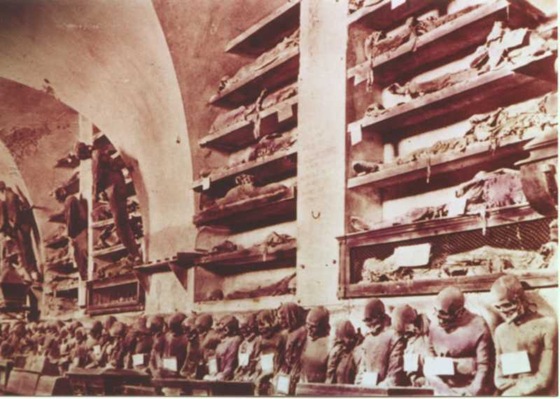
Some 350 years ago, it was discovered that the catacombs contained a mysterious preservative that helped mummify the d-ead. As a result, Sicilians from nobles to maids -- at least 8,000 in all -- demanded to be buried here. The oldest corpses date from the late 16th century. The last corpse to be buried here was that of 2-year-old Rosalia Lombaro, who d-ied in 1920. She still appears so lifelike that locals have dubbed her "Sleeping Beauty." Giuseppe Tommasi, prince of Lampedusa and author of one of the best-known works of Sicilian literature, The Leopard, was buried here in 1957. His body was not embalmed, but buried in the cemetery next to the catacombs instead.

Visitors can wander through the catacombs' dank corridors among the mummified bodies. Some faces are contorted as if posing for Edvard Munch's The Scream. Although many corpses are still remarkably preserved, time and gravity have been cruel to others. Some are downright creepy, with body parts such as jaws or hands missing.
 for more images click here
The Capela dos Ossos was built in the 16th century by a Franciscan monk who, in the Counter-Reformation spirit of that era, wanted to prod his fellow brothers into contemplation and transmit the message of life being transitory. This is clearly shown in the famous warning at the entrance Nós ossos que aqui estamos pelos vossos esperamos (“We, the bones that are here, await yours.").
The lugubrious chapel is formed by three spans 18.7 meters long and 11 meters wide. Light enters through three small openings on the left. Its walls and eight pillars are decorated in carefully arranged bones and skulls held together by cement. The ceiling is made of white painted brick and is painted with death motifs. The number of skeletons of monks was calculated to be about 5000, coming from the cemeteries that were situated inside several dozen churches. Some of these skulls have been scribbled with graffiti. Two desiccated corpses, one of which is a child, dangle from a chain. And at the roof of chapel, the phrase "Melior est die mortis die nativitatis (Better is the day of death than the day of birth)" (Ecclesiastes, 7, 1) from Vulgate is written. [link]
Four enormous bell-shaped mounds occupy the corners of the chapel. An enormous chandelier of bones, which contains at least one of every bone in the human body, hangs from the center of the nave with garlands of skulls draping the vault. Other works include piers and monstrances flanking the altar, a large Schwarzenberg coat of arms, and the signature of Rint, also executed in bone, on the wall near the entrance. [link]
Several intact skeletons draped in Fransciscan habits are dotted around the chambers, which are said to have inspired the Sedlec Ossuary (above).
In 1210, when an adjacent cemetery ran out of space, a room was built to hold bones. A church was attached in 1269. Renovated in 1679, it was destroyed by a fire in 1712. A new bigger church was then attached to the older one and dedicated to Saint Bernardino of Siena.
The interior has an octagonal plan, with Baroque-style decorations. The several chapels have paintings from the 16th-18th centuries.
The ossuary's vault was frescoed in 1695 by Sebastiano Ricci with a Triumph of Souls and Flying Angels, while in the pendentives are portrayed the Holy Virgin, St. Ambrose, St. Sebastian and St. Bernardino of Siena. Niches and doors are decorated with bones, in Roccoco style. [link]
Beneath its floor is a mass grave containing the remains of another 21,000 people who died during the Thirty Years’ War (1618–1648), or due to cholera and hunger. While those exhumed to create the grizzly interior decorations were never consulted during life, the bones of those that created the sinister sideshow also rest in the Skull Chapel, in a last macabre nod to their “sanctuary of silence”.
From the 18th century, poor burial procedures and hopeless overcrowding in Parisian cemeteries were causing widespread disease among inhabitants. It was decided that the dead would be buried in a the large system of tunnels (actually depleted quarries) beneath the city, and the long process of moving them all began. While the bones were originally just piled up and labeled, French officials eventually realized that the catacombs could become a major tourist attraction. The bones were tidied and arranged in neat displays, with stacks of tibiae and skulls forming lovely – if macabre walls.
The ossuary was founded in the 17th century, and was expanded in the 18th century. It's been opened to public since June 2012.
[Sources: squidoo.com / urbanghostsmedia.com / weburbanist.com]
 Creepy by today's standards, these churches decorated from floor to ceiling with human skeletal remains were often used in places where major plagues had hit or where burial space had become scare. Though the original intention in many areas was for bones to be buried when space became available, many of these remains are still up and hanging in these bone churches as a testament to this peculiar religious tradition.
Like catacombs, charnel houses, reliquaries and other religious structures, ossuaries have become an offbeat tourist attraction for those looking to learn more about some of the less frequently told stories in European history. Spooky and scary, a trip to these ossuaries is a great destination for anyone seeking something to creepy to do while they vacation in Europe.
The Beinhaus (Bone House) in Hallstatt, Austria
The town of Hallstatt looks like the kind of Austrian town that the Sound of Music might have been set in. On a beautiful forested mountain, next to a perfectly blue lake, filled with charming 19th century houses, the town is a perfect vision of cheer. Except of course, for the room filled with skulls.
Behind the Hallstatt Catholic Church, near the 12th-century St. Micheal's Chapel, in a small and lovingly cared for cemetery is the Hallstatt Beinhaus (Bone House), also known as the Charnel House. A small building, it is tightly stacked with over 1200 skulls. Because Hallstatt finds itself in such a lovely location, it also finds itself in very short supply of burial grounds.
In the 1700s, the Church began digging up corpses to make way for the newly dead. The bodies which had been buried for only 10 to 15 years were then stacked inside the charnel house. Lest this all sound overly callous to the memory of the dead, there is actually a charm to the whole affair that Hallstatt can't seem to escape even with a room full of skulls.
Once the skeletons were exhumed and properly bleached in the sun, the family members would stack the bones next to their nearest kin. In 1720 a tradition began of painting the skulls with symbolic decorations as well as dates of birth and death so that the dead would be remembered, even if they no longer had a grave. Of the 1200 skulls, some 610 of them were lovingly painted, with an assortment of symbols, laurels for valor, roses for love, and so on. The ones from the 1700s are painted with thick dark garlands, while the newer ones, from the 1800s on, bear brighter floral styles.


Though this practice has been dying out since the 1960s, there is a much more recent skull in the Beinhaus. Beside the cross with a gold tooth is the skull of a woman who died in 1983. Her last request was to be put in the Beinhaus. Her skull was entered into the ossuary in 1995, the very last bone to be placed in the Beinhaus. [link]
The Skull Cathedral of Otranto, Italy
Before dismissing the image as yet another pretty picture of a medieval church, take a closer look. Yes, those are skulls! Instead of the usual altar pictures, there’s a wall of skulls, displayed prominently for the church congregation. Meet the martyrs of Otranto Cathedral in Italy’s Apulia region…The year was 1480 and the fateful day July 28 when a fleet of 70 to 200 Ottoman ships reached the city of Otranto, then part of the Kingdom of Naples. It was the beginning of the Ottoman wars (1453-1683) in Europe and invader Mohammed II had conquered Constantinople just 28 years earlier. The garrison and the citizens took cover in the Castle of Otranto but as it had no cannons for defense, it was soon conquered and the garrison killed.

On August 12, 800 citizens were taken to the hill of Minerva, now called the Hill of the Martyrs, and beheaded because they refused to renounce their Catholic faith. Their remains were taken to the cathedral and the skulls preserved in the altar piece as a prominent reminder of these 800 martyrs. [link]

Skull Tower of Niš, Serbia
The Skull Tower in Serbia is the only bone collection on this list that is actually meant to inspire terror in those who see it. However, the terror incited by the tower was meant for a long-ago enemy.In 1809, the Serbian rebel army suffered a significant setback in their quest for freedom from the Ottoman Empire. The commander of the Turkish army ordered the heads of the fallen Serbs to be cut off and mounted on a tower to warn anyone who might try to fight against the Empire. A total of 952 were once a part of the Skull Tower, but over the years deterioration and family members have claimed most of the skulls. Only 58 remain today, and a chapel was built to protect the tower. It stands today as a monument to the brave Serbs who fought for their independence.


The Capuchin Catacombs of Palermo, Italy
If you've got a secret yearning to join mummified cadavers, and your tastes lean to the bizarre, you should spend at least an hour at these catacombs under the Capuchins Monastery.Some 350 years ago, it was discovered that the catacombs contained a mysterious preservative that helped mummify the d-ead. As a result, Sicilians from nobles to maids -- at least 8,000 in all -- demanded to be buried here. The oldest corpses date from the late 16th century. The last corpse to be buried here was that of 2-year-old Rosalia Lombaro, who d-ied in 1920. She still appears so lifelike that locals have dubbed her "Sleeping Beauty." Giuseppe Tommasi, prince of Lampedusa and author of one of the best-known works of Sicilian literature, The Leopard, was buried here in 1957. His body was not embalmed, but buried in the cemetery next to the catacombs instead.
Visitors can wander through the catacombs' dank corridors among the mummified bodies. Some faces are contorted as if posing for Edvard Munch's The Scream. Although many corpses are still remarkably preserved, time and gravity have been cruel to others. Some are downright creepy, with body parts such as jaws or hands missing.
for more images click hereThe Chapel of Bones, Evora, Portugal
The Chapel of Bones (Capela dos Ossos) is one of the best known monuments in Evora, Portugal. It is a small interior chapel located next to the entrance of the Church of St. Francis. The Chapel gets its name because the interior walls are covered and decorated with human skulls and bones.The Capela dos Ossos was built in the 16th century by a Franciscan monk who, in the Counter-Reformation spirit of that era, wanted to prod his fellow brothers into contemplation and transmit the message of life being transitory. This is clearly shown in the famous warning at the entrance Nós ossos que aqui estamos pelos vossos esperamos (“We, the bones that are here, await yours.").

The lugubrious chapel is formed by three spans 18.7 meters long and 11 meters wide. Light enters through three small openings on the left. Its walls and eight pillars are decorated in carefully arranged bones and skulls held together by cement. The ceiling is made of white painted brick and is painted with death motifs. The number of skeletons of monks was calculated to be about 5000, coming from the cemeteries that were situated inside several dozen churches. Some of these skulls have been scribbled with graffiti. Two desiccated corpses, one of which is a child, dangle from a chain. And at the roof of chapel, the phrase "Melior est die mortis die nativitatis (Better is the day of death than the day of birth)" (Ecclesiastes, 7, 1) from Vulgate is written. [link]

 image source
The Sedlec Ossuary, Kutná Hora, Czech Republic
The Sedlec Ossuary is a small Roman Catholic chapel, located beneath the Cemetery Church of All Saints in Sedlec, a suburb of Kutná Hora in the Czech Republic. The ossuary is estimated to contain the skeletons of between 40,000 and 70,000 people, whose bones have in many cases been artistically arranged to form decorations and furnishings for the chapel. The ossuary is among the most visited tourist attractions of the Czech Republic, attracting over 200,000 visitors yearly.Four enormous bell-shaped mounds occupy the corners of the chapel. An enormous chandelier of bones, which contains at least one of every bone in the human body, hangs from the center of the nave with garlands of skulls draping the vault. Other works include piers and monstrances flanking the altar, a large Schwarzenberg coat of arms, and the signature of Rint, also executed in bone, on the wall near the entrance. [link]


Santa Maria della Concezione dei Cappuccini, Rome, Italy
The Capuchin Crypt is a subterranean ossuary beneath the church of Santa Maria della Concezione dei Cappuccini in Rome. Divided into five chapels, the crypt contains the remains of 4,000 Capuchin friars buried between 1500 and 1870. Soil was brought from Jerusalem and bodies typically spent 30 years decomposing before their bones were exhumed to form a morbidly decorative display.Several intact skeletons draped in Fransciscan habits are dotted around the chambers, which are said to have inspired the Sedlec Ossuary (above).


San Bernardino alle Ossa, Milan, Italy
San Bernardino alle Ossa is a church in Milan, northern Italy, best known for its ossuary, a small side chapel decorated with numerous human skulls and bones.In 1210, when an adjacent cemetery ran out of space, a room was built to hold bones. A church was attached in 1269. Renovated in 1679, it was destroyed by a fire in 1712. A new bigger church was then attached to the older one and dedicated to Saint Bernardino of Siena.

The interior has an octagonal plan, with Baroque-style decorations. The several chapels have paintings from the 16th-18th centuries.

The ossuary's vault was frescoed in 1695 by Sebastiano Ricci with a Triumph of Souls and Flying Angels, while in the pendentives are portrayed the Holy Virgin, St. Ambrose, St. Sebastian and St. Bernardino of Siena. Niches and doors are decorated with bones, in Roccoco style. [link]
Skull Chapel, Czermna, Poland
Built in 1776, the Skull Chapel in Czermna, Poland, was the bizarre brainchild of parish priest Wacław Tomaszek, who saw to it that the bones of 3,000 people came to line the walls of the small baroque church.Beneath its floor is a mass grave containing the remains of another 21,000 people who died during the Thirty Years’ War (1618–1648), or due to cholera and hunger. While those exhumed to create the grizzly interior decorations were never consulted during life, the bones of those that created the sinister sideshow also rest in the Skull Chapel, in a last macabre nod to their “sanctuary of silence”.


Catacombs of Paris, France
The bone-lined catacombs under Paris are arguably the most famous – and undoubtedly the largest – underground ossuary in the world.From the 18th century, poor burial procedures and hopeless overcrowding in Parisian cemeteries were causing widespread disease among inhabitants. It was decided that the dead would be buried in a the large system of tunnels (actually depleted quarries) beneath the city, and the long process of moving them all began. While the bones were originally just piled up and labeled, French officials eventually realized that the catacombs could become a major tourist attraction. The bones were tidied and arranged in neat displays, with stacks of tibiae and skulls forming lovely – if macabre walls.


Brno Ossuary, Brno, Czech Republic
Brno Ossuary is an underground ossuary in Brno, Czech Republic. It was rediscovered in 2001 in the historical centre of the city, partially under the Church of St. James. It is estimated that the ossuary holds the remains of over 50 thousand people which makes it the second-largest ossuary in Europe, after the Catacombs of Paris (below).The ossuary was founded in the 17th century, and was expanded in the 18th century. It's been opened to public since June 2012.

[Sources: squidoo.com / urbanghostsmedia.com / weburbanist.com]


