Showing posts with label Plants. Show all posts

Mar 12, 2012

World’s First Vertical Forest in Milan

First-Vertical-Forest-01

Bosco Verticale is an ambitious eco project in Milan, designed by architect Stefano Boeri, which tries to blend two discrepant mediums, urban and nature, into one harmonic whole. The project is comprised of  two towers with giant cantilevered staggered balconies that permit fairly big trees to be accommodate, since there is a minimum of two storeys over every balcony. Basically, it’s a vertical forest in the heart of a blooming metropolis.

First-Vertical-Forest-02

There is a wide insufficiency of urban green spaces in cities worldwide, and so much could be obtained with just a tree for every small building. Boeri takes it to a whole new level, up that is, with great results.

First-Vertical-Forest-03

The vertical forest will offer its residents, as well as the rest of Milan’s populace, a cleaner, greener life, as it will produce humidity and oxygen, absorb CO2 and dust particles,  and protect from radiation and acoustic pollution.

First-Vertical-Forest-04

The Bosco Verticale, composed of two residential towers of 110 and 76 meters height, is currently under construction in the centre of Milan, on the edge of the Isola neighbourhood, and will host 900 trees (each measuring 3, 6 or 9 m tall) , alongside a wide range of shrubs and flowers.

First-Vertical-Forest-05

If the apartments would have been constructed individually, the entire project would require 50,000 square meters of land, and 10,000 square meters of woodland.

First-Vertical-Forest-06

Plant irrigation will be made filtering and reuse of the grey waters produced by the building.

First-Vertical-Forest-07

The two towers, upholding to its sustainable, renewable new age bran will also feature an array of other sustainable tech, like photovoltaic and aeolian energy systems.

First-Vertical-Forest-08

First-Vertical-Forest-09

First-Vertical-Forest-10

First-Vertical-Forest-11

The towers under construction in the heart of Milan.

First-Vertical-Forest-12

Via: zmescience.com / All photos credits courtesy of Stephano Boeri

Jan 11, 2012

Benefits of Plants [INFOGRAPHIC]

The very survival of the human race (in fact of all the animals) is challenged without plants. Apart from being the source of food and nutrients for all the animals on the planet, plants keep the environment healthy by absorbing carbon dioxide and reducing global warming. The infographic below depicts some quantifiable as well as unquantifiable benefits of plants:

Infographic via: http://www.thegardencentral.com/plant-garden/benefits-of-plants/

Nov 10, 2011

Top 10 Most Poisonous Plants

The worlds most deadliest plants. The good news, most of the deadliest plants will kill you only if you eat them. If you wanted to find the Top 10 Most Poisonous Plants then you have come to the right place.

Some plants cannot be touched without a resulting rash. It goes without reason that if it causes a rash, then you should not eat it. But other plants look good enough to eat. These plants will kill you.

Get familiar with the plants in this list. Some you know. Some you heard of. It is most important that you recognize them and avoid them.


10. The Rosary Pea

The Rosary Peaphoto source

May 30, 2010

World's Fastest Plants

Bunchberry - World's fastest plant explodes with pollen

0505_canadian_dogwood_02 Cornus canadensis (bunchberry or Canadian dogwood) grow in dense carpets in the tiaga or boreal forests of the northern hemisphere. Flowers bloom in late spring and produce small, edible, red berries during the summer. Credit: J. Edwards.

Like a medieval catapult, the bunchberry dogwood shoots pollen grains into the air faster than the Venus flytrap can snap its jaws shut, giving this launcher the speed record for plants.

"Most people think of plants as stationary and sedentary," said Joan Edwards of Williams College. "We were even surprised how fast this flower opens."

Feb 27, 2010

World’s Oldest Living Trees

Methusalah Tree 00 These are the world’s oldest known individual (non-clonal) living trees today.

According to the US Department of Agriculture, “One acre of forest absorbs six tons of carbon dioxide and puts out four tons of oxygen, enough to meet the annual needs of 18 people.”

The US National Wildlife Federation said, “There are about 60 to 20 million spaces along American cities where trees could be planted which translates to the potential to absorb 33 million more tons of CO2 every year, and saving $4 billion in energy costs.”

“Trees properly placed around buildings can reduce air conditioning needs by 30 percent and can save 20 to 50 percent in energy used for heating,” this according to the USDA Forest Service.

Trees are also great noise absorbers and facilitate better management of flood water, among other environmental benefits.

For millennia, the following trees seem to not get tired of serving their purpose for mankind and mother earth. If they can talk and don’t suffer from Alzheimer’s disease, they sure have so many long interesting stories to tell.

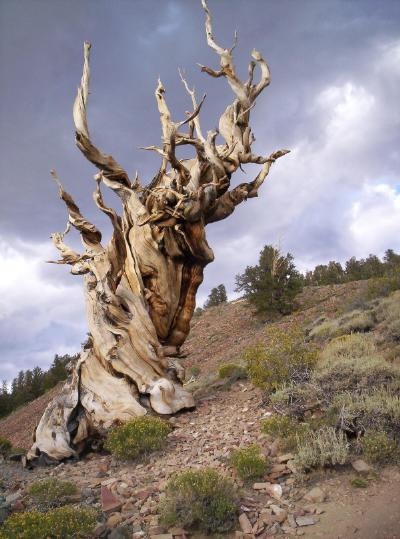
Methuselah
Methusalah Tree 01

Methuselah is a Great Basin Bristlecone Pine (Pinus longaeva) tree found in the Inyo National Forest of California, USA. The tree was estimated to have germinated in 2832 BC and was 4,789 years old when sampled in 1957. Today, it is known as the oldest living individual (non-clonal) organism on earth at 4,841 years old.

Methuselah is growing somewhere in a place called “Forest of Ancients” in Methuselah Grove, but its exact identity and location is kept a secret to keep people from getting near the tree to have their pictures taken or to protect it from any form of vandalism.

The tree was named after Methuselah, who according to the Bible, lived to be 969 years old although the tree has lived five times longer to date.

Sarv-e Abarqu

Sarv-e Abarqu 02_resize

Zoroatrina Sarv, more commonly known as Sarv-e Abarqu, a name which means “cypress of Abarqu” is an Iranian national monument and a major tourist attraction. It is a cypress tree believed to be more than 4,000 years old found in Abarghood in the province of Yazd. Sarv-e Abarqu was named after the city near Yazd. It is known as the oldest cypress tree and probably the oldest living thing in Asia.

Llangernyw Yew

Llangernyw Yew 03

The churchyard of St. Digains’ parish church in a village called Llangernyw in Wales is home to a mighty yew tree. The ancient tree is said to be 4,000 years old making it one of the oldest living things in the country. In June 2002 during the golden jubilee celebration of H.M. Queen Elizabeth II, the tree was recognized as a national heritage together with 49 other trees.

Alerce

Alerce 04_resize

Chile is home to more than 50% of the southern hemisphere’s temperate rain forests, covering almost 85 million acres—second in size only to the forests of the Pacific Northwest. It is South America’s only temperate rain forest and contains some of the world’s largest and oldest trees including the gigantic Alerce trees. In the Valdivian Coastal Reserve in southern Chile is where a 3,639 year old Alerce tree can be found together with other ancient Fitzroya cupressoides, a giant sequoia look-alike species that exist only in the temperate forests of Chile. Also called Andean Birch trees, Alerces have a life span of up to 4,000 years.

The ancient Alerce tree, which was dated 3622 in 1993 is the second-greatest fully verified (by counting growth rings) age for any living tree, after Methuselah. The annual ring count is measured through a small core taken with an increment borer.

Senator

Senator tree 05_resize

The Senator (Taxodium distichum) is the largest and oldest Bald Cypress tree in the United States, found in Big Tree Park, Longwood, Florida. Named in honor of former Florida State Senator M.O Overstreet who donated the tree and the surrounding land for a park to Seminole County, The Senator is estimated to be 3,400-3,500 years old today. At this age, it means that the tree has been standing when the Egyptians were raising their first pyramids along the Nile; and when Christ was born, The Senator was already a forest giant.

Source

Jan 12, 2010

World's Largest Flower

Rafflesia arnoldii is a member of the genus Rafflesia. It is noted for producing the largest individual flower on earth, and a strong odor of decaying flesh - the latter point earning it the nickname of "corpse flower". It occurs only in the rainforests of Sumatra and Borneo in the Indonesian Archipelago. Although there are some plants with larger flowering organs like the Titan Arum and Talipot palm, those are technically clusters of many flowers.

Several species of Rafflesia grow in the jungles of southeast Asia, including the Philippines. Many of them are threatened or endangered. The flower of Rafflesia arnoldii is the largest which attains a diameter of nearly one meter (3 ft) and can weigh up to 11 kilograms (24 lb).

It lives as a parasite on the Tetrastigma vine, which grows only in primary (undisturbed) rainforests. Rafflesia lacks any observable leaves, stems or even roots, yet is still considered a vascular plant. Similar to fungi, individuals grow as thread-like strands of tissue completely embedded within and in intimate contact with surrounding host cells from which nutrients and water are obtained. Perhaps the only part of Rafflesia that is identifiable as distinctly plant-like are the flowers; although, even these are unusual since they attain massive proportions, have a reddish-brown coloration and stink of rotting flesh, which is why it was nicknamed the "corpse flower". This scent attracts insects such as flies which then pollinate the rare plant. It is not to be confused with the Titan Arum, Amorphophallus titanum, which is also commonly referred to as the "corpse flower".

Rafflesia arnoldii is rare and fairly hard to locate. It is especially difficult to locate the flower in forests as the buds take many months to develop and the flower lasts for just a few days. The flowers are unisexual and thus proximity of male and female flowers is vital for successful pollination. These factors make successful pollination a rare event.

How many of these plants still survive is unknown, but as the remaining primary forests of Borneo and Sumatra disappear, it can only be assumed that their numbers are dwindling. Many are known to be nearing extinction. Some environmentalists are thinking of a way to recreate the species' environment, in an effort to stimulate a recovery in the population of this endangered species. This has proved unsuccessful so far, but the efforts have continued. Steps are also being taken to conserve the forests of Sumatra and Borneo.


Source

Dec 17, 2009

The Biggest Pumpkin - 1725 pounds

Talk about a great pumpkin. With Halloween around the corner, two Ohio pumpkin growers may have a world record-breaking gourd on their hands.

Nick and Christy Harp of Jackson Township, near Canton, brought a pumpkin weighing 1,725 pounds to the annual Ohio Valley Giant Pumpkin Growers weighoff last Saturday, making them a shoo-in for the biggest pumpkin title -- and possibly a Guinness-certified World Record.

"I kind of knew I had a good shot at the world record, but when it hit the scale, it was just happy, I was crying, thought I was gonna pass out," Christy Harp told Cleveland's Fox News affiliate, as reported on Fox8.com. She has been growing pumpkins since the eighth grade, and has a friendly rivalry with husband Nick.

"Last year he beat me by 200 pounds. This year I beat him by 400 pounds," Christy said. "Very good year! My pumpkin, my side of the patch! We separate the patch and never step foot on the other side!"

At one point in August, the massive pumpkin was growing 33 pounds a day, Christy told Fox News. She kept it going by plying the soil with a mix of compost, coffee grounds and cow manure, though seeds with good genetics are also key.

Taking the pumpkin-growing title was a thrill for the entire family.

"Nick got emotional, Christy got emotional and I have to admit her mother and I did, too," Christy's father, Denny Dieffenbaugh, told Fox News. "It was a very proud moment for us."

Contest organizers told The Associated Press that the Harps' entry topped the 1,689-pound world record-holder grown in 2007 by Joe Jutras of North Scituate, R.I.

And, according to the AP, some lucky folks can score a piece of the prize-winning pumpkin: The seeds will be dried and given to anyone who asks.

Source: nydailynews.com

Dec 7, 2009

The Heaviest Seed - Coco de Mer

The Coco de Mer belongs to the Coryphoidae subfamily and tribe Borasseae. Borasseae is represented by four genera in Madagascar and one in Seychelles out of the seven worldwide. They are distributed on the coastlands surrounding the Indian ocean and the existing islands within. Borassus, the genus closest to Lodoicea, has about five species in the "old world," one species in Africa, one in India, South-East Asia and Malaysia, one in New Guinea and two species in Madagascar.

The Coco de Mer is the most interesting species of the six monospecific endemic palms in Seychelles since it is the "only true case of island gigantism among Seychelles flowering plants, a unique feature of Seychelles vegetation". It is one of the most universally well-known plants and holds three botanical records; the largest fruit so far recorded weighed 42 kg; the mature seeds weighing up to 17.6 kg are the world's heaviest and the female flowers are the largest of any palm.

Of the six endemic palms it is the only dioecious species, with male and female flowers located on different plants. A selective review of the biology of the species was recently published by Edwards, Kollmann & Fleischmann (2002).


Source: wikipedia.org

Dec 6, 2009

The Largest Tree - General Sherman

The largest trees in total volume are those which are both tall and of large diameter, and in particular, which hold a large diameter high up the trunk. Measurement is very complex, particularly if branch volume is to be included as well as the trunk volume, so measurements have only been made for a small number of trees, and generally only for the trunk. No attempt has ever been made to include root volume. Measuring standards vary.


The top five species measured so far are:

  1. Giant Sequoia Sequoiadendron giganteum: 1,487 m³ (52,508 cu ft), General Sherman
  2. Coast Redwood Sequoia sempervirens: 1,203 m³ (42,500 cu ft), Lost Monarch
  3. Montezuma Cypress Taxodium mucronatum: 750 m³ (25,000 cu ft), Árbol del Tule
  4. Western Redcedar Thuja plicata: 500 m³ (17,650 cu ft ), Quinault Lake Redcedar
  5. Kauri Agathis australis: circa 400 m³ (15,000 cu ft), Tane Mahuta tree (total volume, including branches, 516.7 m³/18,247 cu ft)
   

General Sherman is the name of a Giant Sequoia with a height of 275 feet (83.8 metres). As of 2002, the volume of its trunk measured about 1487 cubic meters, making it the largest non-clonal tree by volume. The tree is located in the Giant Forest of Sequoia National Park in the United States, east of Visalia, California. The tree is believed to be between 2,300 and 2,700 years old.
 

In 1879, it was named after American Civil War general, William Tecumseh Sherman, by naturalist James Wolverton, who had served as a lieutenant in the 9th Indiana Cavalry under Sherman. In 1931, following comparisons with the nearby General Grant tree, General Sherman was identified as the largest tree in the world. One upshot of this process was that wood-volume was widely accepted as the defining factor in establishing the world's largest tree.


Source: wikipedia.org