


A microcar is the smallest automobile classification, usually
applied to very small cars (smaller than city cars). Such small cars
were generally referred to as cyclecars until the 1940s. More recent
models (1960 and later) are also called bubble cars due to their
bubble-shaped appearance.
The heyday of these cars was surely in the mid- to late 1950s, when post-war Europe turned to creating mobility solutions for the masses. The original Mini and Fiat 500 may be the most recognisable machines, but we present our choice of ten of the most unusual microcars from this era:

image source
The Peel P50 is a three-wheeled microcar originally manufactured from 1962 to 1965 by the Peel Engineering Company on the Isle of Man. It currently holds the record for the smallest automobile to go into production. It has no reverse gear, but a handle at the rear allows the very lightweight car to be physically maneuvered when required.

image source
Designed as a city car, it was advertised as capable of seating "one adult and a shopping bag." The vehicle's only door was on its left side, and equipment included a single windscreen wiper and only one headlight. Standard colours were Daytona White, Dragon Red and Dark Blue. The 1963 model retailed for £199 when new (about £1,400 in 2010, or $2,200 USD). 50 of them were produced, and only 27 of them are known to be still in existence. [link]

Shelby GT350 vs Peel P50 [image source]

image source
The Allard Clipper was first created in the UK in 1953 by the sports car maker Sydney Allard. Despite winning the 1952 Monte Carlo Rally in a sports car of his own design, the sales of Allard sports cars were swamped by manufacturers like Jaguar and so Sydney Allard decided to design an economical car. The Allard Clipper was designed by David Gottleib and had an "indestructible" plastic body that was made by Hordern-Richmond Ltd. This made it the first car to have a plastic body. It was powered by a 346cc Villiers twin engine that powered one of the rear wheels.

image source
Unfortunately the Allard Clipper was to suffer from many problems that included cooling and weak drive shafts and so manufacture ceased in 1955 after only about twenty vehicles were made. It is believed to date that only two vehicles still exist. [link]
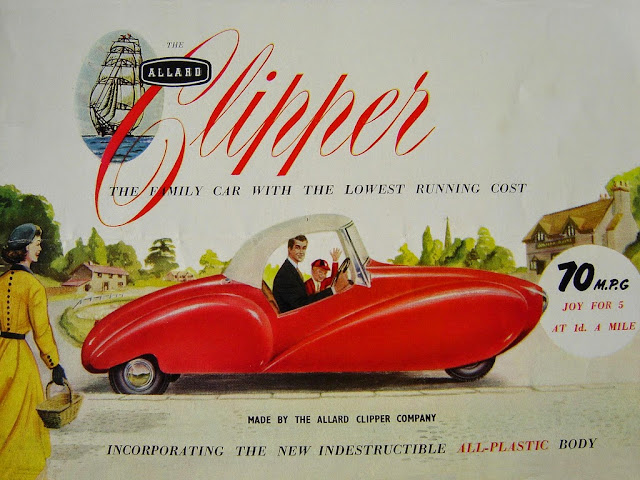
image source

BMW Isetta [image source]
The BMW Isetta is among the most iconic microcars, but was not developed by the German automaker. Refrigeration magnate Renzo Rivola saw an opportunity to create the small economical car he yearned for, acquiring the patents for a design that would become the Isetta – diminutive of Iso, the name of his company.

1953 Iso Isetta [image source]
At just over two metres long, the egg-shaped Iso Isetta was unique in having a single door on its front, to which the steering column and instrument panel were attached. Early models were three-wheelers, but a fourth wheel was later added for stability. Its 236cc two-stroke engine produced all of 9.5 horsepower, comparable to the output of riding lawnmowers of today. [link]

image source

The Messerschmitt KR200, or Kabinenroller (Cabin Scooter), was a three-wheeled bubble car designed by the aircraft engineer Fritz Fend and produced in the factory of the German aircraft manufacturer Messerschmitt from 1955 to 1964.

The three-wheeled KR175 (and later KR200) was powered by a single-cylinder two-stroke engine and coined the bubble car because of its jet-like canopy. Officially known as the Kabinenroller, it sat two in tandem and featured an oversize steering wheel more suited to aircraft than passenger cars. Its interior was rudimentary at best – the only instrumentation was a speedometer. [link]

images source

1955 English ad. [image source]

1959 Scootacar Mk 1 [image source]
Scootacar was a British three-wheeled microcar built in Hunslet, Leeds by Scootacars Ltd a division of the railway locomotive builder, the Hunslet Engine Company between 1957 and 1964.

image source
It was allegedly built because the wife of one of the directors wanted something easier to park than her Jaguar. The shape of the car was designed by Henry Brown who did it by sitting on a Villiers engine and then having an assistant draw an outline around him. The body was built in glass fibre and was very tall for its size being 60 in (1,524 mm) high, 87 in (2,210 mm) long and only 52 in (1,321 mm) wide. It was nicknamed "the telephone booth". Two people could be carried with a passenger behind the driver or alternatively just squeezed in alongside. Power came from a Villiers 9E 197 cc single cylinder 2 stroke engine coupled to a four speed motorcycle type gearbox and chain drive to the single rear wheel. Steering was by handlebars. The top speed was 50 miles per hour (80 km/h). [link]

image source

Built by Paul Vallée, a wealthy industrialist who foresaw the need for scooters in post-war Europe, this three-wheeled microcar was cloaked in a streamlined, teardrop-shaped fibreglass body created by the founder of the Ecurie France racing team.

The interior featured a bench seat and a D-shaped steering wheel to ease access. Equipped with an inertial Gyrostarter system derived from helicopters to start the two-stroke, single-cylinder 125cc engine, the car was mercifully less successful than Vallée had hoped. Only 200 were built before he turned his attention toward a more profitable venture – buying into a Rolls-Royce and Ferrari dealership. [link]


images source: Darin Schnabel, RM Auctions

image source
The car had its origins in France in the late 1940s, where aircraft and car designer and manufacturer Gabriel Voisin had designed a minimal car called the Biscooter for Avions Voisin. The playful name implied that it was about the size of two motorscooters, or a scooter with four wheels. The design drew no interest from either manufacturers or consumers there, however, and he eventually licensed it to Spanish firm Autonacional S.A. of Barcelona. By the time it was introduced in 1953, the marque had been hispanicized to Biscúter. The first car had no formal model name and was called simply the Series 100, but it soon became known as the Zapatilla, or little shoe (clog), after a low-heeled peasant slipper popular at the time.

image source
The Zapatilla was minimal indeed, with no doors or windows or reverse gear. The 1 cylinder, 197 cc, two-stroke motor produced 9 horsepower (7 kW), had a crank starter, and drove only the right front wheel. Braking was by an unusual three-point system involving the transmission and cable ties to the two rear wheels. One genuinely advanced feature was an all-aluminum body, although steel was later used. [link]

image source

image source
The prototype shown by Mr. Hannoyer (Reyonnah backwards) at the Paris Salon of 1950 evolved over the next few months to a definitive production form. The open "torpedo" body tub with the sweeping curved cowl and sides, became a convertible with a side-hinged top mounted on the now straight sides. The windshield no longer folded, the headlamps were deeper, rear fenders flatter, and wheels (from the Simca Cinq) changed in pattern. Different lifting tops were seen, including canvas soft tops, hardtops with sunroof, and clear bubbles.

image source
This fascinating car sacrifices ergonomics for design, however. It is difficult to imagine a lady in a '50's tight skirt clambering over the tall sides into the tub. The large steering wheel and controls are stuffed into a cramped knuckle-bruising space under the front cowl. And finally, its front suspension "trick" does not allow for a lock in the "up" position, so that moving the car forward with suspension "up" causes it to collapse back to "down", defeating its purpose of rolling it into a tight spot like a motorcycle. [link]

image source
The Daihatsu Bee is a three-wheeled microcar produced by the Japanese manufactuer Daihatsu from 1951.

image source
Although Daihatsu had been producing motorized tricycles for carrying freight since 1930, and had also produced a small car for military use in 1937, the Bee was the first passenger car the company built for sale to the general public. The car was marketed from October 1951, shortly before the company changed its name from 'Hatsudoki Seizo Co' to Daihatsu.

image source
Photographs show the car with a two-door fibreglass body, though other sources state that it had a four-door body instead and as a result was popular as a taxi. Power was provided by a rear-mounted 540 cc OHV air-cooled two-cylinder four-stroke engine. It was the first car in Japan with a horizontally opposed engine. The car was adapted from one of Daihatsu's three-wheeled delivery trucks. It sold very poorly, production was highly labor-intensive and ceased after only approximately 300 units were built.

image source

image source
With its strong avionic design cues, it shouldn’t surprise that this microcar was actually built by the national aeronautic society of northern France. Arguably the most attractive of the three-wheelers, the Inter featured a single headlamp in its fuselage-inspired body and a hinged canopy that included glass windows.

image source
It also introduced a number of innovations, such as a folding front suspension and a Gyrostarter system, which employed a small electric motor and a flywheel to crank-start the engine. Only 280 were built, and no two cars were ever exactly alike. [link]

image source
The heyday of these cars was surely in the mid- to late 1950s, when post-war Europe turned to creating mobility solutions for the masses. The original Mini and Fiat 500 may be the most recognisable machines, but we present our choice of ten of the most unusual microcars from this era:
Peel P50

image source
The Peel P50 is a three-wheeled microcar originally manufactured from 1962 to 1965 by the Peel Engineering Company on the Isle of Man. It currently holds the record for the smallest automobile to go into production. It has no reverse gear, but a handle at the rear allows the very lightweight car to be physically maneuvered when required.

image source
Designed as a city car, it was advertised as capable of seating "one adult and a shopping bag." The vehicle's only door was on its left side, and equipment included a single windscreen wiper and only one headlight. Standard colours were Daytona White, Dragon Red and Dark Blue. The 1963 model retailed for £199 when new (about £1,400 in 2010, or $2,200 USD). 50 of them were produced, and only 27 of them are known to be still in existence. [link]

Shelby GT350 vs Peel P50 [image source]
Allard Clipper

image source
The Allard Clipper was first created in the UK in 1953 by the sports car maker Sydney Allard. Despite winning the 1952 Monte Carlo Rally in a sports car of his own design, the sales of Allard sports cars were swamped by manufacturers like Jaguar and so Sydney Allard decided to design an economical car. The Allard Clipper was designed by David Gottleib and had an "indestructible" plastic body that was made by Hordern-Richmond Ltd. This made it the first car to have a plastic body. It was powered by a 346cc Villiers twin engine that powered one of the rear wheels.

image source
Unfortunately the Allard Clipper was to suffer from many problems that included cooling and weak drive shafts and so manufacture ceased in 1955 after only about twenty vehicles were made. It is believed to date that only two vehicles still exist. [link]

image source
Isetta

BMW Isetta [image source]
The BMW Isetta is among the most iconic microcars, but was not developed by the German automaker. Refrigeration magnate Renzo Rivola saw an opportunity to create the small economical car he yearned for, acquiring the patents for a design that would become the Isetta – diminutive of Iso, the name of his company.

1953 Iso Isetta [image source]
At just over two metres long, the egg-shaped Iso Isetta was unique in having a single door on its front, to which the steering column and instrument panel were attached. Early models were three-wheelers, but a fourth wheel was later added for stability. Its 236cc two-stroke engine produced all of 9.5 horsepower, comparable to the output of riding lawnmowers of today. [link]

image source
Messerschmitt KR200

The Messerschmitt KR200, or Kabinenroller (Cabin Scooter), was a three-wheeled bubble car designed by the aircraft engineer Fritz Fend and produced in the factory of the German aircraft manufacturer Messerschmitt from 1955 to 1964.

The three-wheeled KR175 (and later KR200) was powered by a single-cylinder two-stroke engine and coined the bubble car because of its jet-like canopy. Officially known as the Kabinenroller, it sat two in tandem and featured an oversize steering wheel more suited to aircraft than passenger cars. Its interior was rudimentary at best – the only instrumentation was a speedometer. [link]

images source

1955 English ad. [image source]
Scootacar

1959 Scootacar Mk 1 [image source]
Scootacar was a British three-wheeled microcar built in Hunslet, Leeds by Scootacars Ltd a division of the railway locomotive builder, the Hunslet Engine Company between 1957 and 1964.

image source
It was allegedly built because the wife of one of the directors wanted something easier to park than her Jaguar. The shape of the car was designed by Henry Brown who did it by sitting on a Villiers engine and then having an assistant draw an outline around him. The body was built in glass fibre and was very tall for its size being 60 in (1,524 mm) high, 87 in (2,210 mm) long and only 52 in (1,321 mm) wide. It was nicknamed "the telephone booth". Two people could be carried with a passenger behind the driver or alternatively just squeezed in alongside. Power came from a Villiers 9E 197 cc single cylinder 2 stroke engine coupled to a four speed motorcycle type gearbox and chain drive to the single rear wheel. Steering was by handlebars. The top speed was 50 miles per hour (80 km/h). [link]
image source
Paul Vallée Chantecler

Built by Paul Vallée, a wealthy industrialist who foresaw the need for scooters in post-war Europe, this three-wheeled microcar was cloaked in a streamlined, teardrop-shaped fibreglass body created by the founder of the Ecurie France racing team.

The interior featured a bench seat and a D-shaped steering wheel to ease access. Equipped with an inertial Gyrostarter system derived from helicopters to start the two-stroke, single-cylinder 125cc engine, the car was mercifully less successful than Vallée had hoped. Only 200 were built before he turned his attention toward a more profitable venture – buying into a Rolls-Royce and Ferrari dealership. [link]


images source: Darin Schnabel, RM Auctions
Autonacional Biscúter 100

image source
The car had its origins in France in the late 1940s, where aircraft and car designer and manufacturer Gabriel Voisin had designed a minimal car called the Biscooter for Avions Voisin. The playful name implied that it was about the size of two motorscooters, or a scooter with four wheels. The design drew no interest from either manufacturers or consumers there, however, and he eventually licensed it to Spanish firm Autonacional S.A. of Barcelona. By the time it was introduced in 1953, the marque had been hispanicized to Biscúter. The first car had no formal model name and was called simply the Series 100, but it soon became known as the Zapatilla, or little shoe (clog), after a low-heeled peasant slipper popular at the time.

image source
The Zapatilla was minimal indeed, with no doors or windows or reverse gear. The 1 cylinder, 197 cc, two-stroke motor produced 9 horsepower (7 kW), had a crank starter, and drove only the right front wheel. Braking was by an unusual three-point system involving the transmission and cable ties to the two rear wheels. One genuinely advanced feature was an all-aluminum body, although steel was later used. [link]

image source
1951 Reyonnah

image source
The prototype shown by Mr. Hannoyer (Reyonnah backwards) at the Paris Salon of 1950 evolved over the next few months to a definitive production form. The open "torpedo" body tub with the sweeping curved cowl and sides, became a convertible with a side-hinged top mounted on the now straight sides. The windshield no longer folded, the headlamps were deeper, rear fenders flatter, and wheels (from the Simca Cinq) changed in pattern. Different lifting tops were seen, including canvas soft tops, hardtops with sunroof, and clear bubbles.

image source
This fascinating car sacrifices ergonomics for design, however. It is difficult to imagine a lady in a '50's tight skirt clambering over the tall sides into the tub. The large steering wheel and controls are stuffed into a cramped knuckle-bruising space under the front cowl. And finally, its front suspension "trick" does not allow for a lock in the "up" position, so that moving the car forward with suspension "up" causes it to collapse back to "down", defeating its purpose of rolling it into a tight spot like a motorcycle. [link]

image source
Daihatsu Bee
The Daihatsu Bee is a three-wheeled microcar produced by the Japanese manufactuer Daihatsu from 1951.

image source
Although Daihatsu had been producing motorized tricycles for carrying freight since 1930, and had also produced a small car for military use in 1937, the Bee was the first passenger car the company built for sale to the general public. The car was marketed from October 1951, shortly before the company changed its name from 'Hatsudoki Seizo Co' to Daihatsu.
image source
Photographs show the car with a two-door fibreglass body, though other sources state that it had a four-door body instead and as a result was popular as a taxi. Power was provided by a rear-mounted 540 cc OHV air-cooled two-cylinder four-stroke engine. It was the first car in Japan with a horizontally opposed engine. The car was adapted from one of Daihatsu's three-wheeled delivery trucks. It sold very poorly, production was highly labor-intensive and ceased after only approximately 300 units were built.
image source
1955 Inter 175A Berline
image source
With its strong avionic design cues, it shouldn’t surprise that this microcar was actually built by the national aeronautic society of northern France. Arguably the most attractive of the three-wheelers, the Inter featured a single headlamp in its fuselage-inspired body and a hinged canopy that included glass windows.

image source
It also introduced a number of innovations, such as a folding front suspension and a Gyrostarter system, which employed a small electric motor and a flywheel to crank-start the engine. Only 280 were built, and no two cars were ever exactly alike. [link]
image source


