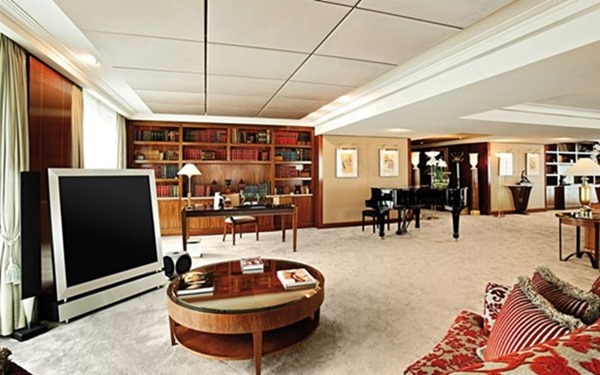
Would you spend more than $65,000 on a hotel stay? Maybe you wouldn't, but as the number of millionaires in the world grows every year, so too does the yearning for the best of the best luxury accommodations made to quell the desires of these richer travelers.
For $19,000 per night, you can enjoy from the big picture down to the fine details, a true luxury hotel intuitively knows how to provide for its guests. At Burj Al Arab Jumeirah they have taken the time to anticipate your every need, putting an incredible array of luxury facilities and services at your fingertips.
Park Hyatt Paris-Vendôme is an exquisitely elegant hotel featuring world-class dining, unique spa experiences, and 153 elegant guestrooms. Centrally located near the best shopping and top attractions in Paris. For one night in Imperial Suite you will pay $20,000.
Atlantis, Paradise Island features the world's largest open-air marine habitat; Aquaventure, a 141-acre waterscape, including the iconic Mayan Temple's Leap of Faith slide; 11 incredible pools; four miles of magnificent beaches; a Tom Weiskopf-designed 18-hole, oceanfront golf course; and the Atlantis Casino. Per night in the Bridge Suite you must pay $22,000.
From an urban oasis atop a dramatic skyscraper, The Ritz-Carlton, Tokyo reveals an elevated experience that inspires memories as vivid as the panoramic views beyond. Admire the authentic Japanese culture of this luxury Midtown hotel's teahouse in the sky. Enjoy dining experiences that impress with both delectable fare and mesmerizing views. For one night in Presidental Suite you must pay $25,000.
The hotel is one of the city's most imposing palaces, rich in history and located on one of the most celebrated and talked about streets of Rome and close to Rome's main attractions. For one night in Villa La Capula Suite you will pay $31,000.
Nuzzled in a 72-acre private peninsula in the Athenian Riviera with stunning views to the Saronic Gulf, the 5 star Grand Resort Lagonissi exceeds all expectations of a luxury sea front summer resort. Per night in the Royal Villa you must pay $32,000.
The hotel’s long and rich history, authentic hospitality and timeless architectural beauty has long established the Grand Hyatt Cannes Hôtel Martinez as the flagship hotel on the French Riviera and as one of the most famous hotels in Cannes. For one night in the Penthouse Suite you will pay $35,000.
Times change, but dedication to perfecting the travel experience never will. Their highly personalized 24-hour service, combined with authentic, elegant surroundings of the highest quality, embodies a home away from home for those who know and appreciate the best. Per one night in Trey Warner Penthouse you will pay $35,000.
Internationally recognized for its exceptional accommodations, high-energy nightlife, extravagant pools and world-renowned restaurants, Palms Casino Resort captures all the excitement and energy of Las Vegas in one vibrant setting. Per night in Sky Villa you must pay $40,000.
Situated on the Leman lake shore and just steps from the most beautiful parks and boutiques of the renowned Rue du Rhône, Hotel President Wilson is one of the most contemporary addresses in Geneva, facing the magnificent panorama of the Mont-Blanc. If you want sleep in their Royal Penthouse Suite you will pay $65,000 per night.
A gold reserve is the gold held by a national central bank, intended as a store of value and as a guarantee to redeem promises to pay depositors, note holders (e.g. paper money), or trading peers, or to secure a currency.
This list presents the gold reserves of largest gold holding countries worldwide as of June 2017.
A flying car or roadable aircraft is an aircraft that can also travel along roads. All the working examples have required some manual or automated process of conversion between the two modes of operation.
A slightly different concept that is sometimes referred to as a "flying car", particularly in science fiction, is that of an aircraft that would be practical enough for every-day travel, but would not necessarily be drivable on the roads.
These are some of the most unusual and unique flying cars. Some were able to fly, some aren’t, but they all deserve their place on this list.
The Moller Skycar is a prototype personal VTOL (vertical take-off and landing) aircraft – a "flying car" – invented by Paul Moller who has been attempting to develop such vehicles for fifty years.
The craft said to be currently under development, the M400, is purported to ultimately transport four people; single-seat up to six-seat variations are also planned. It is described as a car since it is aimed at being a popular means of transport for anyone who can drive, incorporating automated flight controls, with the driver only inputting direction and speed required.
After forty years and $100,000,000 in expenditure the Skycar demonstrated limited tethered hovering capability in 2003. No subsequent testing has occurred, although public demonstrations have been announced and then cancelled. It has been extensively marketed for pre-order sale since the 1990s as Moller attempted to raise more money for 'development' but fifty years on is often cited as a real world example of physical product vaporware. [link]
AeroMobil is a flying car that perfectly makes use of existing infrastructure created for automobiles and planes, and opens doors to real door-to-door travel. As a car it fits into any standard parking space, uses regular gasoline, and can be used in road traffic just like any other car. As a plane it can use any airport in the world, but can also take off and land using any grass strip or paved surface just a few hundred meters long.
The current flying car prototype AeroMobil 3.0 incorporates significant improvements and upgrades to the previous pre-prototype AeroMobil 2.5.
It is now finalised and has been in regular flight-testing program in real flight conditions since October 2014.
The AeroMobil 3.0 is predominantly built from advanced composite material. That includes its body shell, wings, and wheels. It also contains all the main features that are likely to be incorporated into the final product, such as avionics equipment, autopilot and an advanced parachute deployment system.
AeroMobil 3.0 also implements a number of other advanced technologies, such as a variable angle of attack of the wings that significantly shortens the take-off requirements, and sturdy suspension that enables it to take-off and land even at relatively rough terrain.
The Advanced Tactics Black Knight Transformer patented technology is a first-of-its-kind in vertical takeoff and landing aircraft. The vehicle design is highly modular for a wide variety of payloads including a ground drive-train unit that allows it drive like an automobile.
The Black Knight Transformer’s a multi-engine rotorcraft drawing inspiration from small electric “multicopters” that have become popular in the last decade. Unlike the small electric versions, the Black Knight is a full scale aircraft with a significant payload and range capability. The vehicle also has a fully independent ground drivetrain that provides it with off-road driving capabilities so that it can reach any destination, whether a suitable landing zone is available or not. [link]
The Terrafugia Transition is a light sport, roadable airplane under development by Terrafugia since 2006.
The Rotax 912ULS piston engine powered, carbon-fiber vehicle is planned to have a flight range of 425 nmi (489 mi; 787 km) using either automotive premium grade unleaded gasoline or 100LL avgas and a cruising flight speed of 93 kn (107 mph; 172 km/h). Equipment includes a Dynon Skyview glass panel avionics system, an airframe parachute, and an optional autopilot.
On the road, it can drive up to 70 miles per hour (110 km/h) with normal traffic. The Transition Production Prototype's folded dimensions of 6 ft 8 in (2.03 m) high, 7 ft 6 in (2.29 m) wide and 18 ft 9 in (5.72 m) long are designed to fit within a standard household garage. When operated as a car, the engine power take-off near the propeller engages a variable-diameter pulley CVT automatic transmission to send power to the trailing-suspension mounted rear wheels via half-shafts powering belt drives.[8] In flight, the engine drives a pusher propeller. The Transition has folding wings, pusher propeller and twin tail. [link]
This flying car is almost a legend, and besides this photo and a brief mention of the vehicle in a newspaper clipping from Andalusia, Alabama, it might as well have not existed at all. According to the story, the photo above is of Jess Dixon; it was supposedly taken sometime around 1940. Although it’s considered a flying car by aviation history buffs, the machine is actually closer to a “roadable helicopter,” due to the two overhead blades spinning in opposite directions. In other words, it’s a gyrocopter that can also roll. [link]
The AVE Mizar (named after the star Mizar) was a roadable aircraft built between 1971 and 1973 by Advanced Vehicle Engineers (AVE) of Van Nuys, Los Angeles, California. The company was started by Henry Smolinski, a graduate of Northrop Institute of Technology's aeronautical engineering school.
The prototypes of the Mizar were made by mating the rear portion of a Cessna Skymaster to a Ford Pinto. The pod-and-twin-boom configuration of the Skymaster was a convenient starting point for a hybrid automobile/airplane. The passenger space and front engine of the Skymaster were removed, leaving an airframe ready to attach to a small car. AVE planned to have their own airframe purpose-built by a subcontractor for production models, rather than depending on Cessna for airframes.
The entire Mizar was intended for production and expected to sell for less than $19,000. But designer Henry Smolinski and pilot Harold Blake died in a test flight crash. [link 1, link 2]
Aerocar International's Aerocar (often called the Taylor Aerocar) was an American roadable aircraft, designed and built by Moulton Taylor in Longview, Washington, in 1949. Although six examples were built, the Aerocar never entered production.
Taylor's design of a roadable aircraft dates back to 1946. During a trip to Delaware, he met inventor Robert E. Fulton, Jr., who had designed an earlier roadable airplane, the Airphibian. Taylor recognized that the detachable wings of Fulton’s design would be better replaced by folding wings. His prototype Aerocar utilized folding wings that allowed the road vehicle to be converted into flight mode in five minutes by one person. When the rear license plate was flipped up, the operator could connect the propeller shaft and attach a pusher propeller. The same engine drove the front wheels through a three-speed manual transmission. When operated as an aircraft, the road transmission was simply left in neutral (though backing up during taxiing was possible by the using the reverse gear.) On the road, the wings and tail unit were designed to be towed behind the vehicle. Aerocars could drive up to 60 miles per hour and have a top airspeed of 110 miles per hour. [link]
For a 2006 stunt for his reality television show Monster Garage, motorcycle builder Jesse James attached wings, a tail, and an engine to a Panoz Esperante. He then took the creation to an airstrip near Kitty Hawk, N.C., where the Wright Brothers first flew. On his first test flight, James was able to get the 305-hp, Ford V-8-powered Esperante airborne at 80 mph and flew the car for 3 seconds, which translates to about 350 feet of airborne distance. That distance is three times farther than the Wright Brothers flew 108 years ago. [link]
PAL-V (Personal Air and Land Vehicle) is a Dutch company who are developing a roadable aircraft, the PAL-V One.
The PAL-V One in flight is an autogyro or gyrocopter, with a foldable pusher propeller providing forward thrust and a free-spinning rotor providing lift. Directional stability is provided by twin boom-mounted tailfins. It has a tricycle undercarriage with relatively large wheels.
On the ground, the propeller and rotor are stopped and power is diverted to the wheels, allowing it to travel as a three-wheeled car.
The PAL-V One has two seats and a 160 kW flight certified gasoline engine, giving it a top speed of 180 km/h (112 mph) on land and in air, and a Maximum Takeoff Weight of 910 kg. [link]